Forget Prompt Engineering — Context Engineering Is What Matters Now

Prompt engineering had a good run. For about eighteen months, the tech industry convinced itself that the key to AI was writing better instructions. Courses were sold. Certifications were minted. People put "prompt engineer" in their LinkedIn titles.
Then the models got smarter, and the bottleneck moved.
The Prompt Isn't the Problem
Modern language models — Claude, GPT-4, Gemini — are remarkably good at following instructions. If you give Claude a clear task with the right information, it performs. The failure mode is almost never "I asked it wrong." The failure mode is "I didn't give it what it needed."
That's the shift. The craft isn't in the question. It's in the context.
What Context Engineering Actually Is
Context engineering is the discipline of designing what information reaches the model, when, and in what form. It's the difference between an AI that hallucinates company policies and one that quotes them accurately. The difference between an agent that takes five tool calls to find a file and one that already knows where to look.
In practice, context engineering means making decisions about:
What to include. A 200K-token context window sounds enormous until you realise that dumping everything in makes the model slower, more expensive, and paradoxically less accurate. The skill is curation — knowing which 5,000 tokens of context produce better results than 50,000 tokens of noise.
When to retrieve. Static system prompts are table stakes. Production systems use dynamic retrieval — pulling in relevant data at the moment it's needed. Not beforehand (wasteful), not after the model asks (too late). The retrieval timing changes the output quality dramatically.
How to structure. The same information formatted as a wall of text versus a structured schema produces wildly different results. Models are sensitive to hierarchy, ordering, and the relationship between pieces of context in ways that are non-obvious until you've shipped a few systems.
What to exclude. This is the hardest part. Irrelevant context doesn't just waste tokens — it actively degrades performance. Every piece of information in the context window competes for attention. If your customer service AI has the full product catalogue in context when the user is asking about a refund, you've already lost.
Why This Matters for Production Systems
Prompt engineering works fine for one-off queries. You type something into ChatGPT, you get something back, you refine. Interactive, manual, low-stakes.
Production systems don't get that luxury. They run autonomously, at scale, with real consequences. An AI that misroutes a customer ticket costs money. An AI that generates an incorrect compliance report costs more. You can't sit next to the model and nudge it when it goes wrong.
Context engineering is what makes autonomous AI reliable. It's the engineering discipline that ensures the model has the right information, in the right structure, at the right time — without a human in the loop curating each request.
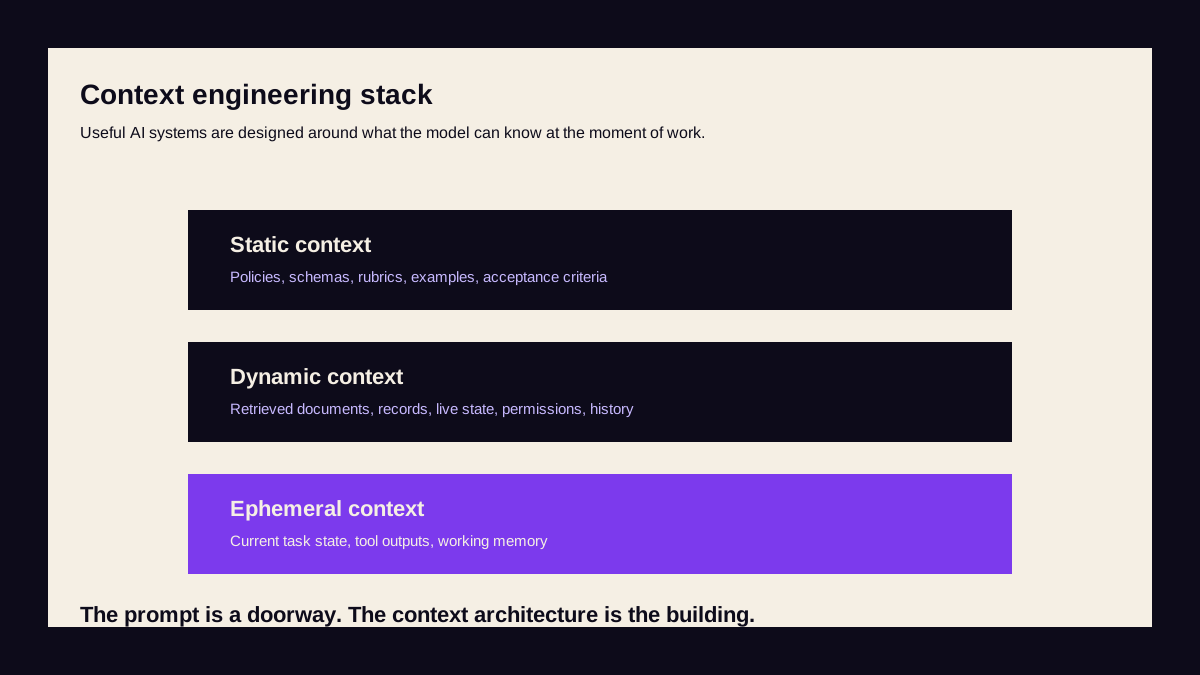
The Three Layers
We think about context engineering in three layers:
1. Static Context (System Design)
This is the foundation: system prompts, tool definitions, schema descriptions, business rules. It changes rarely and applies to every request. The mistake teams make is treating this like a README — writing it once and forgetting it. Static context needs to be tested, versioned, and evaluated just like code.
2. Dynamic Context (Retrieval)
This is the information that changes per request: user history, relevant documents, database records, previous conversation turns. RAG (retrieval-augmented generation) is the most common pattern, but it's not the only one. Sometimes the right move is a SQL query. Sometimes it's a tool call. Sometimes it's reading a file. The retrieval strategy should match the access pattern — not everything needs a vector database.
3. Ephemeral Context (Agent Memory)
This is the newest and least understood layer. When AI agents operate across multiple steps — browsing, coding, searching, reasoning — they accumulate working memory. Managing that memory is context engineering at its most complex. What does the agent remember between steps? What does it forget? When does it summarise versus keep verbatim?
Get these three layers right and your AI system behaves predictably. Get them wrong and you're debugging hallucinations at 2am.
What This Means for Your Team
If you're investing in AI capabilities, the skills that matter are shifting:
Less: writing clever prompts, chaining prompt templates, "jailbreaking" models into doing what you want.
More: designing information architecture for AI consumption, building evaluation frameworks that measure context quality, understanding retrieval systems deeply enough to choose the right one.
The teams that are winning at AI right now aren't the ones with the best prompts. They're the ones that have built systems where the model always has exactly what it needs — no more, no less.
That's context engineering. It's less catchy than prompt engineering, and it doesn't make for good LinkedIn posts. But it's what separates the demos from the systems that actually run businesses.
Related reading
- Claude Code and Codex in Production — what context engineering looks like in our day-to-day engineering workflow, with the
CLAUDE.mdpattern that captures static context. - Domain Intelligence — the service we offer specifically for clients who need to put their domain knowledge into a production AI system without it hallucinating.
- AI-Native Engineering — the broader methodology this discipline sits inside.